Service under pressure feels chaotic?
You're probably losing money -- and not seeing it clearly.
Not because your team isn't good.
But because the system breaks under load.
This is not an open offer. It's a selection.
We are selecting one operation.
Only one.
For a full 90-day AZE Reset.
No fee. Anonymous case study. Selection required.
Selection closes once the right operation is found.
Service feels chaotic under pressure.
Standards fluctuate.
Decisions change depending on who's on shift.
But because the industry is used to variability, this gets accepted as "normal".
It's not.
This is not a people problem.
It's a system design problem.
Most restaurant don't operate on a real system.
They operate on habits, experience, and constant adjustment.
And it works, until it doesn't.
When demand increases,
when team changes,
when pressure builds...
The gap starts to show.
Not all at once, but consistently.
In service.
In communication.
In margins.
And this is where another misconception sits.
Managers -- and even strong General Managers -- are not necessarily system architects.
They can be.
But often they are not.
Running a service and designing the system behind it are two different disciplines.
A good manager can drive performance within a structure.
But that doesn't mean they built that structure -- or that they should.
This is also why most "coaching" in hospitality ends up compensating, not fixing.
It often focuses on behaviours, culture, and motivation -- trying to compensate for something deeper that isn't working.
But culture doesn't fix a broken system.
A strong personalities don't replace structure.
AZE does.
--
If this sounds familiar, Apply for the AZE Open Reset →
This is where AZE exists.
Not to train better reactions.
But to design the system those reactions depends on.
Not as consultancy.
But as an operational intervention.
This is how the operation system gets redesigned.
We step in to redesign how the operation actually runs --
how decisions are made,
how roles interact,
and how the service flows in real time.
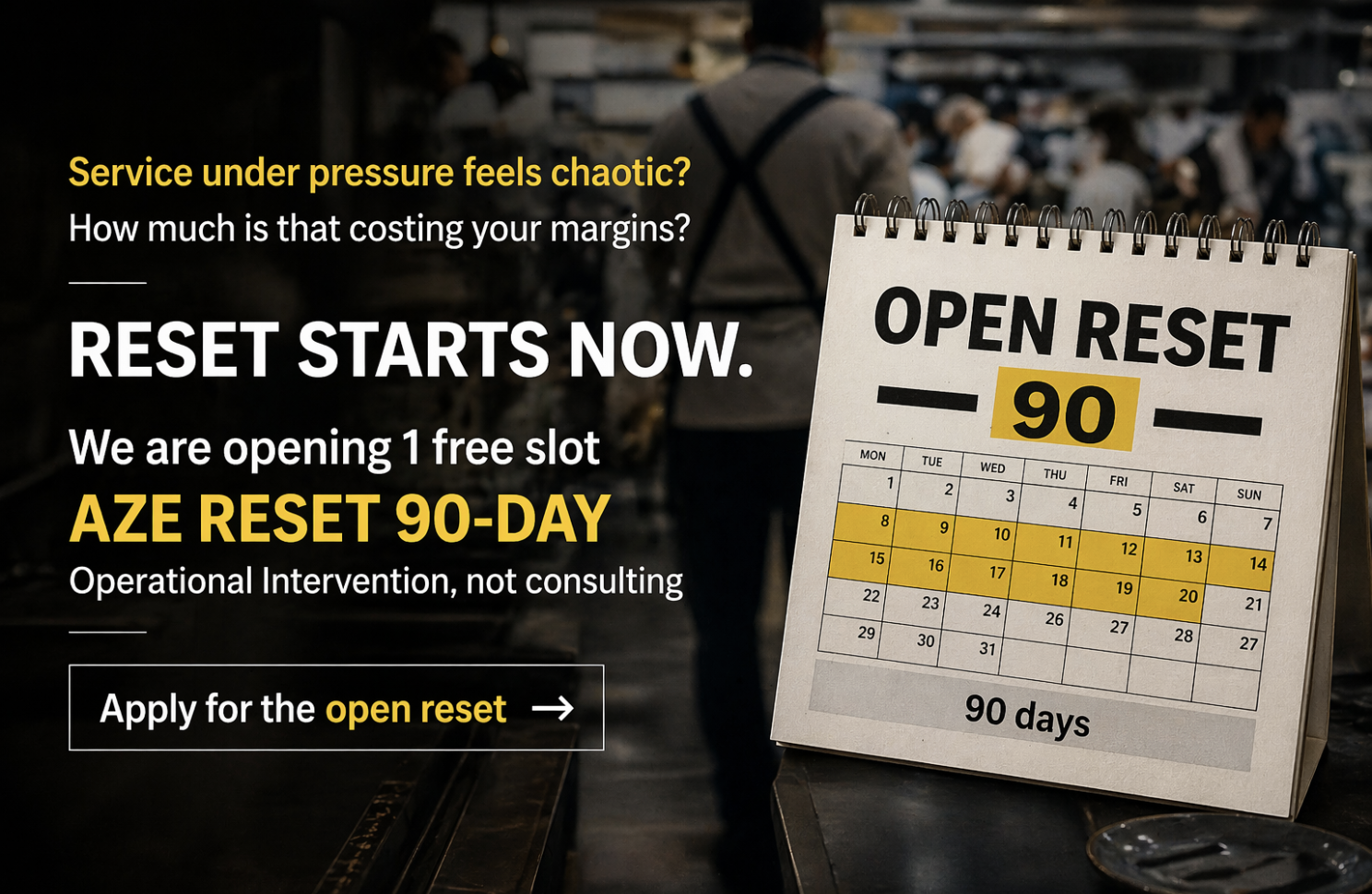
We are opening one FREE Reset.
Not as a promotion.
Not as an offer.
As a case study.
To document what actually changes when operations are designed as a system.
What improves.
What breaks.
What gets fixed.
Without hiding behind theory.
We will work directly with the team.
We'll observe, analyse, redesign, and guide implementation over 90 days.
The process will be real.
The result will be real.
The restaurant will remain anonymous.
The work will not.
We are opening 1 slot.
Zephlog supports management both during live service and ouside of it.
One communication channel focuses on the operational side of the GM role: compliance, rota structure, P&L awareness, orders check, staffing doubts, coordination, priorities, and day-to-day operational decisions.
Another can support the person leading the floor during service in real time.
The goal is not to add another tool managers need to constanly check.
The goal is to reduce cognitive overload and help operations stay alogned while service is happening.
A digital operational assistant built to support the people making decisions — not distract them from service.
Zephlog is not built only for live moments.
It is designed to improve operations over time through consistency, reflection, and recurring operational insights.
Every week, patterns collected across shifts help generate practical observations around coordination, communication, timing, workload distribution, and operational friction.
Not generic consultancy reports.
Real operational feedback built from what is actually happening inside the restaurant.
The objective is simple:
Less chaos.
Better alignment.
Stronger operations over time.
At the start of the day, Zephlog provides a focused operational digest based on recent patterns, ongoing friction points, shift structure, and live context from the restaurant.
Not long reports.
Not dashboards full of graphs.
Just clear operational priorities for the next service.
Simple. Actionable. Useful.
The goal is to reduce noise, improve coordination, and support managers focus attention where it matters most before pressure builds during service.
Z doesn't just collect information.
It looks for what repeats, what impact service, and what creates operational friction.
By combining live support conversations, voice notes, and end-of-day logs, Zephlog starts identifying recurring patterns across shifts.
Not just what happened.
But why it keeps happening.
This allows managers to move from reacting to problems — to recognizing them earlier and operating with more clarity over time.
Real time operational support during service.
Zephlog currently works through direct interaction between ZOPs (Zephlog Operators), internal operational back-end systems, and a lightweight WhatsApp interface.
One channel supports the GM as a digital assistant.
Another supports the person in charge on the floor during live service.
The goal right now is not visual complexity.
The goal is operational impact.
This manual-first structure allows Zephlog to support real restaurants today while the future app and AI infrastructure are being built.
Operational signals are the small indicators that usually appear before operational friction becomes visible.
Right now, Zephlog captures operational signals through real time operational reporting shared directly by managers during service.
When something relevant happens on the floor, managers can quickly send voice notes describing pressure points, guest flow, delays, communication issues or unusual operational dynamics as service unfolds.
Inside the same channel, they can also request live operational support and receive direct responses from ZOPs (Zephlog Operators) in real time.
At the end of the day, a 3 minutes daily logs helps compare live operational perception with the overall service outcome and recurring patterns.
The objective is not surveillance.
The objective is operational awareness before small issues become larger operational problems.